
Before I delve into some of these ideas and moments more in depth, I think it’s key that I start with a basic overview of the Holocaust so that you can have a general understanding of it.
First of all, let’s just take a glimpse into the rise of Hitler and the Nazi Party. As a result of World War I, the German empire fell apart, and the Germans tried to set up a democracy (it was really a constitutional republic, one of the most democratic systems in Europe at the time) known as the Weimar Republic, which was established on November 9, 1918- this was two days before the Armistice was signed that officially ended WWI.
Unfortunately, this Republic was incredibly unstable, in large part because of the economic crisis it endured. It had the misfortune of dealing with the repercussions of the Treaty of Versailles, which not only put all of the blame of WWI on Germany, but also took away Germany’s colonies, drastically reduced its military to be almost non-existent, and established an impossibly high amount of reparations that the Germans had to pay to the Allies for damages during the war. (They had to pay the equivalent of $33 BILLION USD at that time- which I think is more than $500 billion today.)
As you can imagine, their economy was not doing great. So what did the government do? They printed more money. Great idea, right? (Note the sarcasm.) This had detrimental Impacts on the economy, and the Germans faced hyperinflation in the early 1920s to the point where their money was worthless. People literally burned their money to keep their homes warm because it was cheaper to burn their money than buy firewood. People would put piles of money in wheelbarrows to go to the store to buy the bare basics. Children played with piles of money instead of blocks, and made kites out of the money notes. It was a mess, to say the least.

To help fix this crisis, the Allies and Germany worked together to come up with a plan in 1924 that drastically reduced Germany’s annual payments towards their reparations until they could get back on their feet economically, and Germany took loans from the Allied countries, most notably the US. And over the next few years, their economy did start to do better- until that fateful moment on October 24, 1929, when the stock market crashed and the world hurdled into a global economic depression. The US needed Germany to repay those loans, and this crushed the German economy.
So how, might you ask, is this tied to the rise of the Nazis?
Well, the government system in the Weimar Republic meant that numerous parties were elected by the German people into the Reichstag (the parliament) and it was nearly impossible for one party to hold a majority. The people were suffering from the terrible economic crisis, leaving many jobless. There was a general sense of humiliation left from the Treaty of Versailles, which many attributed to the Weimar Republic for accepting the terms of the treaty. And although the Nazi party was a small minority in the Reichstag at the end of the 1920s, after the Great Depression hit, their numbers in the Reichstag continued to climb. By 1932, they had the largest percent of the popular vote in Germany (around 37%.)
The Nazis, with Hitler at the helm, appealed to the people who were hurting and scared during a period of economic and political upheaval and uncertainty. They promised a glorified Germany that would return to its great roots (Make Germany Great Again, anyone?) They played on general prejudices of the population, blaming the Jewish people and the Communists for the downfall of Germany. (Keep in mind that anti-Semitism was nothing new; it had been a feature of society, not only in Germany, for centuries.) The Nazis stroked the ego of German nationalism, promising the people who were drowning in the present misfortunes the golden opportunity to restore German greatness (and for the “pure” German citizens to be at the forefront of this movement.)
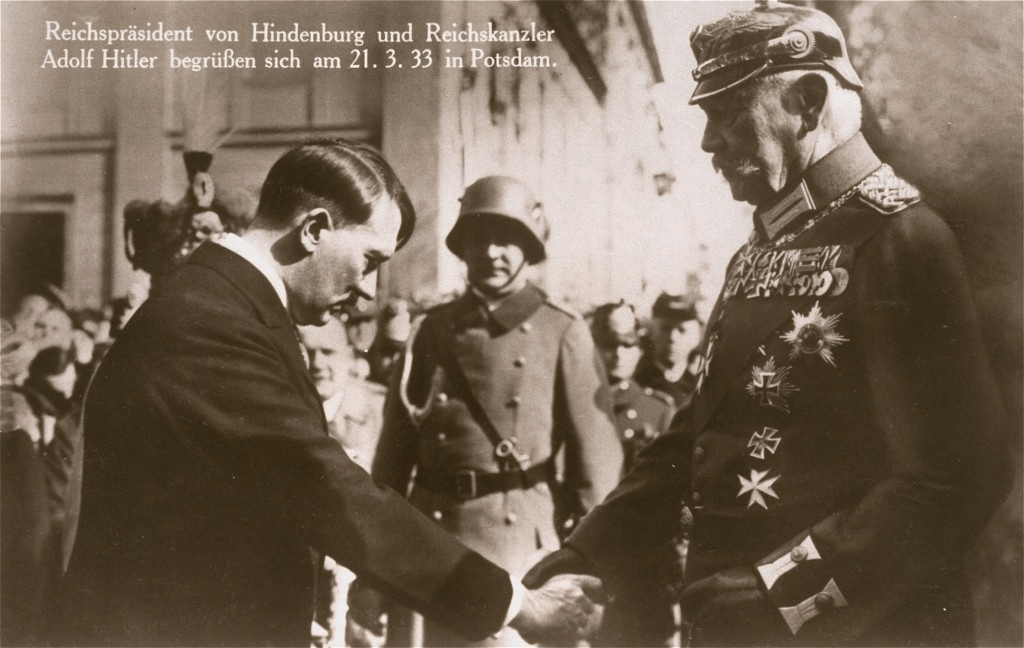
Hitler did not actually gain power until January 30, 1933, when the German President Hindenburg appointed Hitler as Chancellor. This is important, because, although many Nazis were elected the Reichstag, Hitler was never actually elected into his position of power.
When the Reichstag went up in flames four weeks later, the Nazis were quick to blame the Communists. (Although we still don’t know who started the fire, some historians question whether the Nazis did it themselves to set up the stage for Hitler to take control.) Hitler and the Nazis were able to convince the President to utilize emergency constitutional powers (article 48 of the constitution: “If public security and order are seriously disturbed or endangered within the German Reich, the President of the Reich may take measures necessary for their restoration, intervening if need be with the assistance of the armed forces”) to invoke an emergency decree known as the “Decree for the Protection of the People and State.”
What did this decree do?
It eliminated many of the basic freedoms that democracy prides itself on, including freedom of press, freedom of speech, the right to assembly, and restraints on police investigations. Using the supposed Communist threat based on the fire, the government was able to arrest and imprison political opponents of the regime without a specific charge, abolish publications that went against the political goals of the regime, dissolve political organizations, and enabled the centralized government to overrule state and local governments.
Step two of Hitler’s plan to achieve ultimate power? The Enabling Act (formally known as the Law to Remedy the Distress of the People and the Reich) was passed on March 23, 1933. This enabled Hitler to use his position as Chancellor to enact laws of his own free will (he did not need to seek the approval of the Reichstag or the President to do so) even if the laws directly violated the Weimar Constitution.
Keep in mind, even by this point, the multi-party system of the Weimar Republic meant that the Nazis still did not have the majority of the parliament, even though they held the largest percentage of seats. This Act needed a 2/3 vote of the parliament to pass, and, in spite of the allegations that the Communists were the enemies trying to overthrow the government, there were still a significant amount of Communists and non-Nazi party members in parliament itself.
So how did it pass?
Remember that a previous decree made it possible to go after those who were political opponents of the Nazis. The Nazis and Hitler detained all of the Communists from voting (they had 81 seats) and some of the Social Democrats from voting by detaining them in “protective detention” in Nazi camps so they could not be present. During the session itself, the SS and SA (the scary, militaristic police forces that were loyal to Hitler, and would later on play a huge role in the horrors of the Holocaust itself) were present in the chamber to intimidate the members into voting the way Hitler wanted them to.
After this passed, the Supreme Court did nothing to contradict it. It chose to look the other way at the absolutely devious manner in which the law was passed. Many of the justices actually viewed this as a legitimate process and were completely fine with it. (If the Supreme Court had challenged it, would it have changed the outcome of history? Unsure.)
Now, Hitler has basically unchallenged power in the government. But the President is still alive and so, naturally, he is the last obstacle in the way of Hitler’s ultimate dictatorship. When Hindenberg’s death was quickly approaching, Hitler had the Reich Cabinet issue a law that merged the offices of the president and the chancellor, and, upon Hindenberg’s death, would give those powers to Hitler himself. Hindenburg died on August 2, 1934. After his death, Hitler had the power to determine the future of the government and Germany itself.
On August 19, 1934, Hitler abolished the office of the President, and named himself the Fuhrer of Germany after giving the people the “opportunity” to vote on a referendum about this decision. (I say “opportunity” because realistically, there was not much a chance to vote against this guy.) Through a completely unfair and unjust “election”, which used force and intimidation, as well as, I’m sure, voter fraud and other questionable tactics, Hitler’s transition into dictatorship was voted into being by the masses, with a supposed vote of approximately 90% approving his new position of power.

What to take away from this?
First of all, just because there was a lot of coercion and intimidation does not mean that Hitler and the Nazi party were not popular. Many Germans fully supported them, and this cannot be ignored or pushed aside. But at the same time, a lot of Germans did oppose the Nazis. Although it was not safe to do so, there was ultimately choice involved. To say that all Germans had to follow Nazi rule is to ignore the risk and choice that accompanied the people who resisted the Nazis.
Secondly, the Nazis did a LOT to make sure that, on the surface at least, everything seemed to follow a legal order and was legitimate. This is even more frightening, because I can’t help but wonder how many questionable things are going on in our society right now that appear to make legal sense.
And third, there was a TON of violence, corruption, and intimidation that went into these so-called political successes. Within a relatively short period of time, this man completely dismantled one of the most democratic governments on the European continent. And there was not enough of a push back to put a stop to it.

 Thinking Thurlowly
Leave a comment